The Power of Story

I have not given myself an opportunity to blog for some time now, but a recent event particularly inspired me to commit myself again to reflecting about recent activities and learning experiences.  Our E-Learning team facilitated a leadership retreat (#MSLR18) earlier this month for district leaders in Lake Placid, New York.  Leaders were challenged to relax, reflect, and expand their individual horizons through the retreat’s learning activities.  School leaders are not regularly afforded these opportunities – so an event in the summer in Lake Placid was a great place for this type of engagement.

The atmosphere in Lake Placid of tranquility and peacefulness was a perfect setting for recovery, reflection, and personal & organizational introspection.

Our theme for this year is “Building Bridges with Your Stories,” which we carried through the day.  As my team is well aware, I have always been a proponent of “story.”  We are consistently challenging ourselves internally with crafting our vision, initiatives, and projects within the context of story.  What is our narrative?  How do our activities fit together within the overall story of our broader direction?  The story connects to your heart rather than your head – making stories more meaningful, impactful, and memorable than a series of facts, figures, slides, and data points.  In an age of information overload, I have found stories to be particularly helpful in assisting my understanding of vision and direction.

What struck me more than anything at this retreat though was how story can impact in so many different ways and on so many different levels.  My colleague Hilary Dee had a sense of this when the theme was originally developed – but I don’t think even we could predict how the leadership retreat would expand on the power of story.  The presentations and conversations were far beyond how to create and deliver an effective story.  They were about finding your organizational story, your students’ individual stories, your personal story – and then how to internalize these stories to positively influence your actions.  Keynote speaker Paul Reynolds posed the questions below to educators at the retreat – questions that can be framed on so many different levels.

FablePaul questions
Important questions for educators to consistently reflect upon across many different levels.
Paul Reynolds
Paul Reynolds kicks off a day of reflection & learning.

Pete Reilly took it even further when he challenged leaders to look into their heart and find their own story deep inside themselves – as a building block to improving their abilities as school leaders.

The day ended with powerful self-reflection from three talented and introspective educators from our region – Jan Tunison of Scotia-Glenville CSD, Jerry Griffin of Malone CSD, and Dr. Brian Bailey of Ravena-Coeymans-Selkirk CSD.

It was during their presentations of their individual stories that it fully hit me how personal story can be.  The day has led me to reflect about my own story.  I’ve been looking at the progression of my own career and reflecting on how my thinking and direction has evolved – with previous personal experiences serving as building blocks for new directions and experiences.  (How did my thinking evolve to where it is now? Perhaps another topic for a future blog?)

Paul Reynolds summed up the day best when he said “the power of story can be transformative.”  What I hadn’t internalized until the day’s activities was the transformative story is on many different levels and it can (and should) be more than organizational.  It is personal – to each of us, to our teams and colleagues, to our classrooms, and to each of our students.  Each of us has a story and, as both Hilary Dee and Jan Tunison reinforced in their comments at the end of the day, it is what makes us human.

Reflecting on Presenting

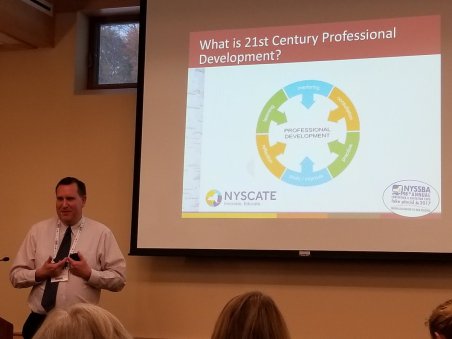
I had the good fortune of presenting last weekend at the @nyschoolboards Annual Convention & Education Expo (#nyssba17) on behalf of @NYSCATE.  My topic was titled Leading Change: 21st Century Professional Development.  Part of my presentation identified reflection as an important activity within contemporary professional learning – and my presentation experience motivated me to practice what I preached by reflecting on the experience (this was the first time I had presented on this particular topic).

NYSSBA PD Present #2

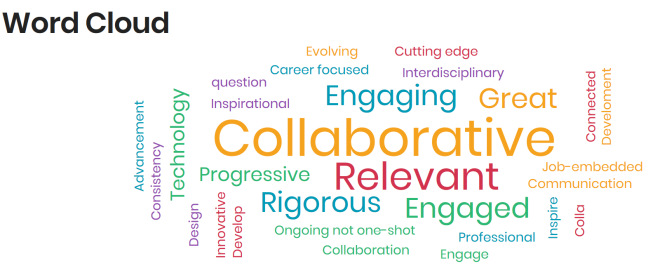
In an effort to model good practice in professional learning, I incorporated some more contemporary elements into the presentation, including back-channeling (@TodaysMeet), data visualization & audience engagement through word clouds (@Mentimeter), and explicit collaboration (via small group dialogue).  Below is the @Mentimeter word cloud developed by session participants, in response to my question to list three (3) characteristics participants think are important in 21st Century Professional Development.

PD Word Cloud
Characteristics of 21st Century Professional Development per #nyssba17 session participants

I was excited with the output of participants – their feedback clearly pegged important elements of 21st century PD.

However, when facilitating professional learning, I find educators still need to work quite hard at incorporating these characteristics into our delivery.  I know I had to work hard last weekend – there is still a natural tendency to want to control the message by serving as the primary source of content on the session topic.  We consistently see this in our classrooms as well – where many instructors are still unable or unwilling to give up control of aspects of learning to students.  Rather than enabling participants (students) to learn from one another or to figure out the answers on their own, presenters (instructors) still often feel the need to provide the answers themselves.

NYSSBA PD Present
Leading Change: 21st Century Professional Development at #nyssba17

Last weekend, I felt increased energy/engagement in the room and an improvement in the learning environment when participants broke into pairs to share their own experiences about how they learn best and what has worked (and not worked) in their own professional learning experiences.  Ultimately, in retrospect, I wish I had incorporated more of these group conversations into the workshop – that activity would have much more closely embodied the characteristics of good PD that participants identified early in the session and likely would have led to more understanding of the workshop topic/theme.

In addition to further refining the flow and activities of the workshop, I’m wondering if @nyschoolboards could help further encourage good professional learning in all of its convention workshops with a couple of tweaks to its format:

  1. Convention presenters are given a power point template to use for all presentations. What is (generally) implied by this requirement is that presenters are to use a slide deck in a stand-and-deliver format.  Perhaps by encouraging some alternatives to a power point template, workshops offered at the convention will utilize more contemporary PD characteristics and facilitate a more robust professional learning experience.
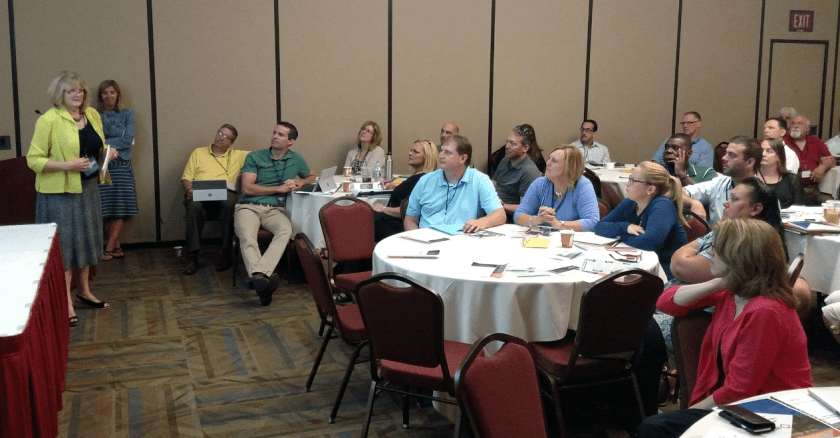
  2. All of the presentation rooms I visited were set up as illustrated in the photo below – presenters in the front and participants sitting in rows of chairs in the middle/back.  While I understand this could introduce space issues, perhaps organizers could ask for and enable alternative room designs that encourage more group dialogue and collaboration.
NYSSBA Makerspace Present
Does this room layout encourage stand-and deliver presentations?

Ultimately, this presentation reinforced my need to continue to be mindful to not fall back into center-of-stage professional learning tendencies and consistently focus on incorporating more collaborative (and less stand-and-deliver) activities.  @kelly_freiheit put it best (and then modeled it best) in a recent PD workshop I attended when she said “If we don’t change our practice, we can’t expect our students to change.”

Ignite Your Story

Last week, our E-Learning team hosted an event for school leaders in our region.  The goal of the event was to “stretch” leaders but in a more relaxed, reflective, and (hopefully) fun environment versus a typical full-day conference.  Our event kicked off with a series of “Ignite Talks” from a handful of our school leaders.

If you are not familiar with the Ignite format – your presentation is limited to five (5) minutes and 20 slides, with each slide automatically advancing after 15 seconds.  It was great to be on the other side of the presentations because about a month ago, colleagues on my team and I each presented an Ignite Talk at a regional administrators’ conference.  This was the first time any of us on the team had presented in such a way, so there was definitely some trepidation about the format.

It was clear from watching the Ignite sessions that presenters (sitting school superintendents and regional directors) both had a lot of fun with the format but were challenged with limiting their presentations to five (5) minutes.  Experienced presenters  Dale Breault and Karen Goldstein noted they spent far more time constructing their 5-minute Ignite than they would for a typical 45-minute presentation.

Ignite BBailey
Dr. Brian Bailey, Superintendent, Ravena-Coeymans-Selkirk CSD, delivers his Ignite Talk

I found the Ignite format is a powerful way to convey a message and tell a story in a very precise way.  To use the Ignite slogan – “Enlighten me, but make it quick!”  Too often, we listen to presentations that try to do too much – too many slides, too much information, no cohesion.  In particular, we see slides used all the time with text presented so small you can’t read it anyway – so what’s the point?

For me, the Ignite session forces presenters to scrap all of that.  It requires you to use visuals to supplement your presentation – but it doesn’t drive your presentation.  It forces you to cut to the chase and focus in on a very small number of main points, which is probably about all attendees can digest anyway.

Ignite RSquier

Ignite CFord-Johnston
Ignite Talks from Randy Squier (Superintendent, Coxsackie-Athens CSD) and Cynthia Ford-Johnston (Interim Superintendent, Peru CSD)

While some folks can be intimidated by the format, Ignite for me was about the most natural way to present.  As my team knows (I say it like a broken record), visuals are key to any presentation and “it’s all about the story” in a presentation – because that is what people remember.  The story connects to your heart rather than your head.  The Ignite format forces you pick important visuals that help reflect the story you are telling.  Plus, in a world where we are all so busy, isn’t five (5) minutes enough time to make your key point?

I’m hoping we are able to facilitate further Ignite Talks throughout the year… and I will be curious to see how the format will be used back in districts.  We started hearing great ideas such as using Ignite at Opening Day, by faculty presenting to peers in faculty meetings, and by students in classroom presentations.  It was truly great seeing experienced superintendents and others “put themselves out there” and try an Ignite Talk.  They seem to have done just that – ignite further conversations about new and different ways to message your story.

Where’s the Innovation?

I’m glad to be back and able to blog – it has been a super hectic couple of months winding down the school year and I’ve been challenged to make time for myself to organize thoughts and reflect.  Included in the hectic end-of-year activities was a trip to the International Society for Technology in Education (ISTE) annual conference in San Antonio.  I’ve been asked by colleagues “how was the conference?” and my honest response to date has been “it was OK.”  The networking with colleagues and conversations with practitioners is always a hallmark of the ISTE conference experience and something I find supremely valuable.

However, my overall mixed feelings about the event stem from the disappointment with the vendor floor.  A significant goal of the ISTE experience is exposure to vendors introducing some of the latest in educational technology innovation hitting/soon to hit our schools.  I was highly surprised at what I perceived as the lack of innovation in what vendors were presenting at the conference.  I’ve heard similar sentiments from others that attended as well.

IMG_20170627_113133010
#ISTE17 Vendor Floor – many vendors, but how much innovation?

In previous years, the ISTE conference was a great place to learn about instructional technologies before they appeared in classrooms.  It was the place to see technology tools and trends with the potential to evolve or even transform the learning experience in our schools.  Technologies such as interactive whiteboards, 3D projection & printing, robotics, and maker components were on the vendor floor at ISTE before they were part of the mainstream conversation.

Unfortunately, I found there was very little presence of these technologies that truly transform the learning experience.  I found the vendor floor to be a steady stream of interactive flat panels, cases & carts for tablets and Chromebooks, and robotics and maker kits – with very little to differentiate one from the other within each product category.  For example, when I asked one interactive flat panel manufacturer what makes their product different from competitors, I was told they had a longer warranty – not a particularly transformative response.  Many of the bigger announcements at the event seem to be about improved functionality to existing products – not revolutionary new products that can introduce/accelerate new learning potential.

IMG_20170628_093413390_HDR.jpg
Not necessarily the innovation desired from vendors at #ISTE17

After my initial feeling of discouragement with this lack of vendor innovation, I reflected further about what could be going on here.  I’m beginning to think we are at a crossroads in ed tech innovation:

  • There is a lull in true transformative innovation from the ed tech vendor community, and
  • True innovation is actually not occurring with products, but by individual practitioners changing learning models using tools that have become more mainstream.  Some of the poster sessions at the ISTE conference reflected this.

Or perhaps something else going on is that vendor technology innovation is still happening, just in other sectors than ed tech.  In particular, innovation appears to be occurring much more rapidly in the business/enterprise world and in the consumer world.  For example, in reading about a notable private sector conference held shortly before ISTE (Wainhouse Research – Infocomm 2017 Review), “ideation” was noted as a buzzword at the conference.  There was nothing of the sort at #ISTE17 from my experience.

This all said, I wouldn’t suggest there was NO innovation apparent at #ISTE17.  I’m finishing up compiling my notes from the event and I’m sure I will blog out a couple of the compelling takeaways I did have from the conference.

Ultimately, I am hopeful that we are simply in a temporary transition phase right now – when vendor innovation is limited but school, classroom, and teacher innovation is happening.  I’m hoping the next phase will be another revolution in technologies that will enable transformative change at a macro/systems level – truly changing what schools look like and what learning can look like.