Think Bigger

I am just finishing the book Not Impossible: Do What Can’t Be Done by Mick Ebeling about dreaming big and realizing that no problem is unsolvable.  Mick provides anecdotes about how he brought teams of motivated individuals together to create products and provide solutions to situations where no one thought a solution was possible.  These actions started with a “Not Impossible” philosophy.

Not Impossible: Do What Can’t Be Done by Mick Ebeling

My timing finishing this book feels quite appropriate because I’ve been involved in a number of recent conversations where I’m feeling we need to Think Bigger as an education community.  Educators are empathetic, they are compassionate, they care about their work and (most importantly) their students.  But when we Think Bigger – we take these human sensibilities to a new level in support of our students.

I recognize this is easier said than done to Think Bigger.  Sometimes we don’t feel capable of Thinking Bigger.  Sometimes we want to Think Bigger but don’t know what “Bigger” looks like.  Sometimes we think we’re Thinking Big but we’re actually not.  Sometimes we want to Think Bigger but those around us don’t.  Sometimes Thinking Bigger can be harder.  Unfortunately, as educators we often default to all of the reasons we can’t do something rather than figuring out how we can.  Funding will always be tight; staffing will always be difficult to find and maintain; many of our students, families, and communities will always struggle with diverse challenges.  But if we are unwilling to shift our mindset to try and move beyond these barriers, will we ever be able to develop our scholars into individuals who will dream big and do what can’t be done?

If we are not thinking big, we are already starting from a deficit mindset.  Instead, let’s start with a Think Bigger mindset.  It shouldn’t matter where our students live or go to school – our technology is such that students can access opportunities most anywhere, regardless of geographic location, demographics, or size.  It shouldn’t matter where our schools are located – all of our schools (even our smallest) are enterprises, requiring so many of the services and supports needed in a typical small-to-medium sized business.  As enterprises, we need to treat ourselves as such and implement solutions more typical of enterprises than of small “mom-and-pop” ventures.

When we Think Bigger, it doesn’t mean we will (or should, for that matter) achieve everything immediately.  But when we Think Bigger, we stretch ourselves and our schools towards an end result befitting of our organizations.

To get to Thinking Bigger, we might want to contemplate the following questions:

  • What does Thinking Bigger mean to each of us personally, and how can we apply it in our own life or profession?
  • What are some specific barriers we face that prevent us from Thinking Bigger, and how might we overcome them?
  • How can educators foster a Think Bigger mindset among their students, colleagues, and communities, especially in under-resourced environments?
  • How can we balance the need for immediate results with the long-term benefits of Thinking Bigger?

Ultimately, if we are expecting our students to continuously grow and to create our next generation of solutions – many of which may appear “impossible” by today’s standards – we need to practice what we preach.  We owe it to our students and to our communities to Think Bigger. 

Thankful for My “Human Network”

I have been wanting to re-initiate blogging for some time and attending the recent New York State Association for Computers and Technologies in Education annual conference (#NYSCATE24) was the catalyst for doing so.  And while there were great conversations and learning opportunities about important topics like generative AI, student wellness and mental health, and New York State’s new “Portrait of a Graduate” initiative for our students, my passion from the conference stems out of something else: connecting with my “human network.”  With the Thanksgiving season upon us, it helped reinforce how thankful I am to be connected with this network.

Exhibit floor at #NYSCATE24 Annual Conference

The NYSCATE organization has always foundationally been a community of educators and partners who believe in the power of technology to positively impact teaching and learning.  The NYSCATE conference annually is a terrific venue where this professional learning community can meet in person to build greater capacity for improving education in New York and beyond.

However, as I reflected on my attendance at this year’s event, it felt even more to me than just a professional community.  Perhaps this feeling was simply because I have attended the conference over 20 times now and feel comfortable with how the conference behaves and who attends the event.  Or perhaps I am just getting to the latter stages of my career and my perspective is shifting.  But I’m realizing it wasn’t just this – there was something else going on here.

Instead, I’m calling these connections my “human network” because it is more to me than a professional network.  I’m not sure if “human network” is the right phrase for these relationships, but it was the one that resonated the most.  My human network is more than what these educators know and can share with me – it is about how this network has impacted me as a person.  These educators and partners are my friends.  They are people who I value and enjoy as individuals.  I have grown up with these people.  My interactions and connection with them have shaped who I am as a person and helped make me the person I am today.  Forget what they have shared with me to support my career in education – I can’t imagine my life without these people in it.

Beyond what the network has done for me, I recognize that I have a place in this too.  As much as these individuals have shaped me as a person, I hope I have been able to give back by supporting these individuals as well. 

So in this Thanksgiving season, I am reminded how fortunate I am to be part of such a remarkable group of individuals who enrich my life in countless ways beyond my professional career. This community of educators and partners is a source of personal growth, friendship, and inspiration.  I look forward to continuing this journey together – learning, growing, and making a difference in the world of education and beyond. Thank you to my “human network” for being such an important part of my personal story.

Relationships, Connected Learning, & ISTE 2019

The International Society for Technology in Education is a community that “believes in the power of technology to transform teaching and learning.”  In reflecting on activities and conversations I was able to participate in at the recent ISTE 2019 conference (#ISTE19), I was amazed though at how little technology was emphasized in these discussions.  Perhaps it was a skewed experience based on the events I attended, but I felt this was one of the first technology-centric conferences where the narrative was truly not about technology – and this (perceived) shift was quite uplifting.

Sure, there was the usual commentary that “technology is just the tool and not the end,” etc. etc.  However, at a conference of technology-minded educators, I was pleasantly surprised how technology was de-emphasized in place of narratives of Relationships and Connected Learning:

Relationships:

1.   During a visit to First Hand Philly, educators discussed the non-profit’s efforts to provide STEM-related learning activities to middle school students.  While the STEM focus was obvious, First Hand Philly emphasized the importance of its proximity to other high-tech companies in Philadelphia.  It was these relationships, where students could connect “first-hand” with career professionals, that provided the greatest influence on the experiences for these middle schoolers.

2.   The Science Leadership Academy, Building 21 in the School District of Philadelphia, and the Philadelphia Learning Collaborative discussed the importance of relationships in their respective missions and focus.

20190622_085804
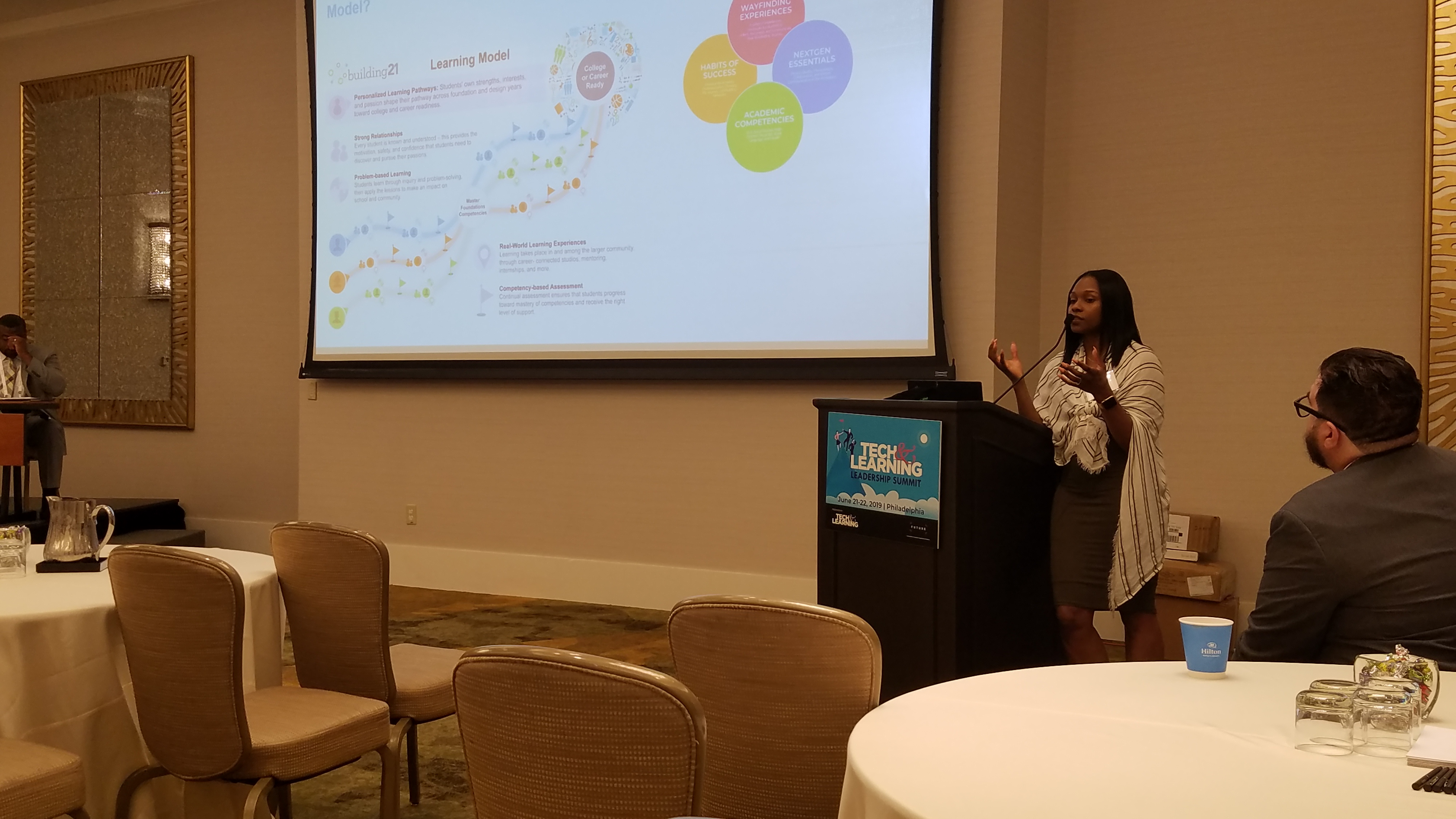
Building 21 Principal Ayris Colvin

Principal Ayris Colvin of Building 21 described how strong relationships with students are critical to the Building 21 learning model.

CEO Chris Lehmann noted how SLA models the teacher-student relationship throughout all of its activities, including the language used by SLA educators.  SLA promotes how teachers care “for” students (a student-centered narrative) rather than teachers caring “about” students (which centers more on the teacher).  Most impactfully, SLA student Horace Ryans described that he had to learn how to be creative and how to collaborate when he came to SLA.  These skills were built through intentional group work activities.  He described how he sat grouped at tables with other students, a classroom design requiring him to make consistent eye contact with his peers.  Ultimately, Ryans said this layout and the corresponding learning activities (such as fishbowl discussions and book discussion pods) promoted creating relationships, exchanging ideas, and learning how to collaborate.

20190622_084617
SLA Student Horace Ryans & CEO Chris Lehmann

Connected Learning:

1.   A visit to Drexel University’s ExCITe Center took participants so far beyond the concept of a STEAM or technology “makerspace.”  The Center demonstrated how connected learning enables the development of new knowledge, lines of thinking, products, and businesses.

20190621_154316
Main makerspace area in Drexel University’s ExCITe Center

Center participants are developing new gaming through its Entrepreneurial Game Studio and innovations in sound, music, and digital media through its Music and Entertainment Technology Laboratory.  These innovations are not focusing specifically on the “tech,” but on creativity and leveraging different areas of expertise and disciplines.

20190621_151312
ExCITe Center’s Magentic Resonator Piano – combining electrical engineering & music

2.   On multiple occasions, school leaders at #ISTE19 moved past simple technology integration in the language they used:

  • Chris Lehmann noted educators are “not engaging with technology, you are just working.”
  • While STEAM touches on this, educators discussed how true connected learning is far greater than just including art or music into “traditional” science/math/engineering activities.
  • In fact, some participants at the pre-#ISTE19 Tech & Learning Leadership Summit were even suggesting we need to ditch the terms “STEM” and “STEAM” because those collective disciplines are treated as something separate from just “learning.”
  • In many conversations I had with #ISTE19 vendors, companies regularly led with the problem they were trying to solve, not the technology they were demonstrating.

Are we turning the corner on the conversation about the connection between technology and learning?  Not sure, but it was at least encouraging to listen to the emphasis on relationships and connected learning in the conversations at an international technology conference – rather than the technology itself.

(Re)Defining Collaboration

As we try to facilitate learning activities in our schools to help prepare students for a rapidly-evolving future, much of the focus is on the key Four C skills of Creativity, Critical Thinking, Communication, and Collaboration.  Collaboration is a skill my team focuses on for all stakeholders in schools (staff, students, etc.) – by providing support for technology platforms and corresponding skills development to better enable collaboration.

In line with our team’s work, I was fortunate recently to attend an event with a targeted focus on Collaboration: Collaboration Week New York (#CWNY19) sponsored by the Interactive Multimedia & Collaborative Communications Alliance (@THEIMCCA).  The event concentrated on evolving solutions and trends within Unified Conferencing and Collaboration, through presentations and visits to leading companies in New York City with broad adoptions of collaboration platforms.

#CWNY19 @ Blackrock
Collaboration Week New York events at BlackRock (above) & Oblong Industries (below)

#CWNY19 @ Oblong

This Collaboration Week event was a striking eye-opener for me for a number of different reasons.

  1. The current use of collaboration technology tools in private sector companies is significantly changing how work is accomplished. Unfortunately, our schools do not appear to be evolving similarly.  Schools have just scratched the surface in using technology to further collaboration in learning activities, as well as to leverage collaboration technologies to evolve the business side of how we operate schools.
  1. Are our schools truly preparing students properly for workplaces, where it matters less and less where you live and when you work?  This question came up over and over again as I learned more about the current trends in the transformation of work.  The latest collaboration technologies enable an anytime/anywhere workplace – but have our schools truly evolved in parallel into an “anytime/anyplace” learning environment, even with our significant investments in educational technologies and our increased focus on shifting pedagogy to student-directed learning?
  1. When we talk about “collaboration” in K-12 schools, the term is often poorly defined or possibly not even defined at all. Learning activities described as “collaborative” are too often just students assigned together in a group.  In these groups, students often work individually on an independent strand of a project, then come together at the end to piece together each individual contribution into a final product of limited cohesion.  In other examples, students in groups simply exchange information and (possibly, in better cases) teach one another, instead of practicing the skills and dispositions truly needed in modern collaborative practices.  Are we truly “collaborating” in schools?

DSC_0237
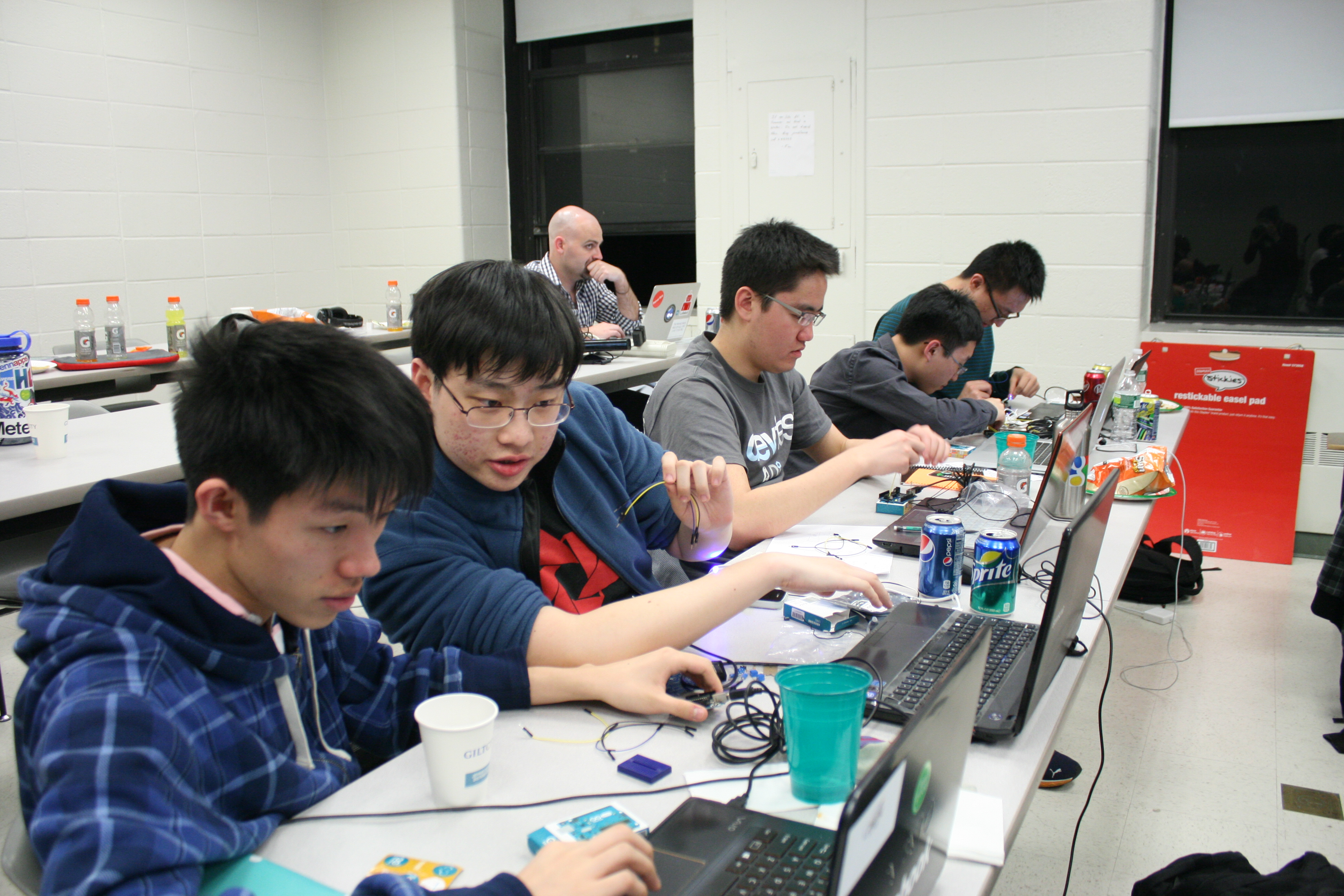
Is student collaboration sharing information, teaching one another, or practicing skills & dispositions?

8675046392_37b5481f62_o

Beyond that – even when students are provided more opportunities to practice collaborative skills within group activities, the conversations are often limited to just others in the classroom.  Per a survey within our region last year, roughly two (2) out of every (3) students indicated they are never asked to collaborate online with students in other schools or from different communities and cultures.  In the workplace presentations I attended at Collaboration Week, technology platforms are leveraged to enable collaboration across global markets, where employees from different countries and cultures are working together daily toward company goals.

Perhaps one (sort of) encouraging sign from #CWNY19 was to learn that, in spite of some of their successes, private companies still do regularly struggle with fully enabling collaboration among its employees.  Beyond the obvious technology barriers (lack of funding, system integrations, choice of tools, etc.), companies still struggle with adoption.  Some employees are uncomfortable with collaborative environments and the technologies that enable/transform the experience.  This admission made me feel a little better (sadly) because many of our K-12 schools still struggle with very similar challenges – embracing good instructional practices in collaboration and adopting technology tools to transform the collaboration experience in learning activities.

I hope to dive deeper into collaboration in subsequent blog postings, exploring what may need to change to better enable it in schools and how technology innovations are going to change collaboration – whether we are ready for it or not.  More to come from the experiences from Collaboration Week New York & new technology announcements from this week’s Enterprise Connect conference, and how these tremendous shifts in collaboration technologies/practices could trickle into our schools.